

Connecticut: The Best State in America (yes, I said it)
What’s in a Name? Everything, Actually.
Before we even get to the good stuff — the gold, the glory, the basketball trophies — let’s talk etymology, because Connecticut’s very name is a flex. The word “Connecticut” comes from the Algonkian/Algonquian word Quinetucket, meaning “beside the long, tidal river.” The Connecticut River, that grand silvery thread running down the heart of the state, earned its indigenous name honestly. It is, in fact, long. It is, in fact, tidal. Connecticut has been describing itself accurately since before it was even a state. Honesty from day one — that’s Connecticut for you.
The French came along and corrupted the Algonkian pronunciation (as the French are wont to do with other people’s words), and eventually the spelling settled into something the English could manage. The river, the name, and the reputation for getting things right have stuck ever since.
Born in 1636 — And Already Running Things
Connecticut didn’t waste time. The colony was officially founded in 1636 when a group of Puritans, led by Thomas Hooker, left Massachusetts and established a settlement at present-day Hartford. Think about that for a moment. The founding fathers of Connecticut looked at Massachusetts — already considered quite good — and said, “Nice try. We’re going to build something better, and we’re going to do it right here, beside the long tidal river.”
Reverend Thomas Hooker is considered the “Father of Connecticut” — a towering figure in colonial New England, one of the great preachers of his time, and the inspiration behind what many consider the world’s first written democratic constitution. He didn’t just found a colony; he founded a philosophy. The man basically invented the idea that regular people should have a say in how they’re governed. You’re welcome, democracy.
Connecticut’s Founding Fast Facts
- Founded: 1636 by Thomas Hooker and Puritan settlers from Massachusetts
- First written democratic constitution in the world: The Fundamental Orders, 1639
- Royal Charter from King Charles II: 1662
- 5th state to ratify the U.S. Constitution: January 9, 1788
- One of the original 13 colonies
- George Washington called it “The Provisions State” for feeding his army
The Constitution State: Because Someone Had to Invent Democracy
Connecticut didn’t just participate in American history. It basically wrote the user manual.
In 1639, the Connecticut Colony wrote and adopted the Fundamental Orders — a document that reflected an independent spirit and is considered by many to be the first written constitution of a democratic government. That’s why Connecticut is nicknamed “The Constitution State.”
The Fundamental Orders created a system in which magistrates were elected and laws were made by an elected assembly — at a time when the region consisted of several self-governing settlements not yet chartered as a colony. Many historians consider it the first written constitution to establish a representative government. While other colonies were still figuring out the basics, Connecticut was already holding elections. Move fast, break things — only Connecticut did it with town meetings and parliamentary procedure.
But Connecticut wasn’t done constitutionalizing. At the Constitutional Convention in 1787, delegates Roger Sherman and Oliver Ellsworth proposed the Connecticut Compromise — a plan that resolved a major disagreement about congressional structure by proposing a two-house legislature: the House of Representatives with proportional representation, and the Senate with equal representation for each state. The compromise became the model for Congress itself.
In other words, the entire structure of the United States federal government is, at least in part, a Connecticut invention. Texas will tell you everything is bigger there. Connecticut will quietly point out that it invented the framework that holds the whole country together.
The Geography: An Overachiever’s Topography
Connecticut has no business being this geographically interesting. It is, after all, the third smallest state in the nation — a fact that Connecticut residents accept with the serene confidence of someone who drives a very fast car. Size is irrelevant when the landscape is this varied.
Travelers to Connecticut can experience a wide range of activities, from historical exploration to outdoor adventures — Mystic Seaport and Aquarium showcasing maritime history and marine life; New Haven with Yale University, museums, and vibrant culinary experiences; Litchfield Hills, perfect for hiking, scenic drives, and fall foliage; and Hartford, the state capital, featuring cultural attractions and historic landmarks.
Here’s the topographical miracle Connecticut pulls off daily: you can wake up, walk a Long Island Sound beach, drive an hour north into the Litchfield Hills, hike a ridge with views of three states, then head home in time for dinner. The coastline alone stretches over 250 miles of bays, harbors, beaches and coves, making it the most pleasantly surprising maritime state east of Maine. The Connecticut River Valley, meanwhile, is an agricultural patchwork of farms, vineyards, and tobacco fields so photogenic – they should charge admission.
And yes — there is skiing. In the 1930s, skiing became a popular pastime at Mohawk State Park in Cornwall, which became famous for documenting the first artificial snow. Ski resorts dot the northwestern hills, offering slopes that won’t intimidate beginners but will absolutely satisfy a spontaneous powder day. The best part? You can ski in the morning and be enjoying dinner at a restaurant with ocean views by evening.
A Seasonal Feast
Can we take a moment to talk about the seasons? No state rolls up its sleeves like Connecticut. We embrace every season with the eagerness of a puppy. There is so much to do throughout the year!
Spring gives us flower farms, hikes to waterfalls, spring festivals, museums and aquariums.
Summer in Connecticut is defined by its 618-mile coastline, world-class pizza, and a deep-rooted maritime heritage that truly comes alive in the warmer months.
Autumn (my personal favorite) Autumn in Connecticut is arguably the state’s most iconic season, famous for some of the best leaf-peeping in New England and a deep-rooted harvest culture. There are so many farms that offer Apple Picking (click HERE), pumpkin picking, hay rides, not to mention fall festivals, antiquing, and scenic drives.
Winter offers the traditional sports of ice skating, skiing, tubing, vintage train rides, Holiday lights, and cozy fireside dining. Did you know that Easton, CT is the Christmas Tree Capital of Connecticut? Easton is a premier Holiday destination featuring over 10 active tree farms, offering cut-your-own and pre-cut trees. The town, recognized for its agricultural heritage, attracts thousands annually for a traditional, family-friendly experience.
Spring

Dogwood blossoms in Fairfield, river thaws, and the Gold Coast awakens from its cashmere hibernation. Connecticut is also the home to the largest pick your own tulip farm!
Summer
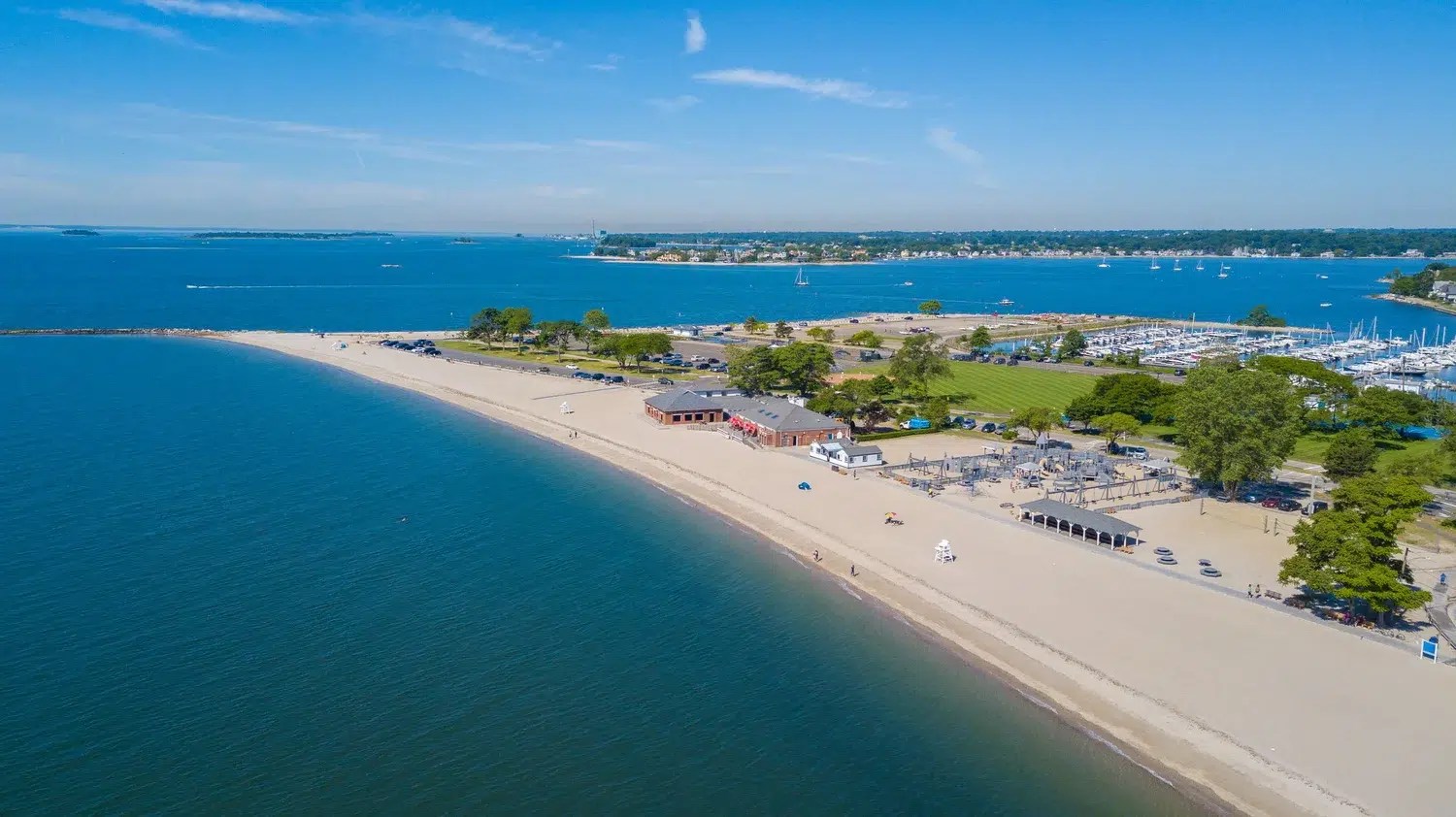
Long Island Sound beach days, Mystic sunsets, vineyard weekends and sailboats on every harbor. This photo is of Compo Beach in Westport, CT my playground when I was a teenager.
Autumn

The most spectacular foliage in America blazes across the Litchfield Hills. Tourists weep openly.
Winter

Ski slopes, cozy inns, Yale hockey, and a 90-minute train to a Broadway show you’ve been waiting to see. Students at Yale walking to class in the winter.
The Gold Coast: Where Wealth Gets Scenic
Let’s talk about the elephant in the cashmere turtleneck. Connecticut is extraordinarily wealthy, and it is not shy about it.
The Gold Coast — also known as Lower Fairfield County — refers to an affluent stretch of western Connecticut roughly 50 miles northeast of New York City, home to many wealthy Manhattan business executives. Towns like Greenwich, Darien, Westport, New Canaan, and Wilton have become bywords for a particular kind of American success: the kind that comes with a wraparound porch, a Metro-North pass to Grand Central, and children who play lacrosse exceptionally well. Everyone drives a Tesla. Including me.
A staggering 17.9% of households in the Fairfield County region earn enough to put them in the top 5% of Americans — the densest concentration of wealth in the entire country. Let that sink in. The densest concentration of wealth in the entire United States of America is not in Manhattan. It’s not in Beverly Hills. It is, humbly, in Connecticut.
Why does everyone rich end up here? Greenwich alone, almost twice the size of Manhattan, is home to titans of finance, the business world, and Hollywood elites. Famous past residents include Paul Newman, Martha Stewart, Ron Howard, and Diana Ross. Westport has been a creative haven for artists and writers since the early 1900s. Fairfield has been called one of the preppiest and most livable places in America. And every last one of these towns is within commuting distance of New York City, making Connecticut the world’s most elegant suburb.
The Gold Coast has been portrayed in popular culture as a bastion of wealth, featured in novels and films including Revolutionary Road, The Stepford Wives, Mr. Blandings Builds His Dream House, and the Showtime drama Billions, which highlights the area’s prominence as a haven for hedge funds and financial services firms. Connecticut has inspired entire genres of American anxiety about success. It’s basically the setting for every movie where someone drives a Volvo and questions their life choices — which is to say, it’s aspirational.
Broadway? Oh, It’s Just Around the Corner.
Here is the recreational miracle that Connecticut residents take completely for granted and should absolutely be rubbing in everyone else’s faces: you can, on the same weekend, ski a mountain in the morning, swim in the Sound in the afternoon, and see a Broadway show at night. This is not a fantasy itinerary. This is just a reasonably ambitious Saturday.
The Metro-North New Haven Line deposits commuters — and theater enthusiasts — directly into Grand Central Station in under 90 minutes. New York City’s entire cultural apparatus, from the Metropolitan Opera to Madison Square Garden to the greatest restaurants on earth, is essentially Connecticut’s backyard entertainment system. Meanwhile, Connecticut’s own arts scene is no afterthought: the Westport Country Playhouse has been launching Broadway-bound productions for nearly a century, Hartford’s TheaterWorks and Long Wharf Theatre are nationally recognized, and New Haven’s arts district — anchored by Yale — is one of the most vibrant small-city cultural scenes in America.
You get the mountains. You get the ocean. You get the city. You keep the trees and the quiet and the farmers markets on Saturday morning. It is, frankly, an absurd amount of lifestyle for one small state to offer.
Education: Connecticut Invented That Too
Of course Connecticut would have Yale. It would be rude not to.
Yale University, founded in 1701, is the third oldest university in the United States — one of the eight Ivy League schools, widely regarded for high academic standards, selectivity in admissions, and social prestige. In recent global rankings, Yale was ranked second in the world, behind only the University of Oxford. Second in the world. In Connecticut. A state you can drive across in an hour and forty-five minutes.
Yale’s graduates include U.S. Presidents William Howard Taft, Gerald Ford, George H.W. Bush, Bill Clinton, and George W. Bush. The inventor of the cotton gin (Eli Whitney) and the man who gave us the first American dictionary (Noah Webster) were both Yale men. Yale students also claim credit for inventing the Frisbee, tossing pie plates from the Frisbie Pie Company and calling “Frisbie!” to warn passersby. From constitutional democracy to recreational discs — Yale, and Connecticut, contain multitudes.
But Yale is only the beginning. The University of Connecticut, Trinity College, Wesleyan University, Fairfield University, Sacred Heart University — Connecticut is so full of excellent institutions of higher learning that it has more colleges per capita than nearly anywhere in the country. The state has long been called a “Knowledge Corridor,” and honestly, that might be underselling it.
Connecticut’s Hall of Inventions
- First written democratic constitution in the Western world (1639)
- First functioning submarine — the Turtle, built by David Bushnell (1776)
- World’s first practical helicopter, built by Igor Sikorsky in Stratford (1939)
- World’s first telephone directory, published in New Haven (1878)
- First nuclear-powered submarine, USS Nautilus, launched in Groton (1954)
- The cotton gin — Eli Whitney, New Haven
- Vulcanized rubber — Charles Goodyear
- The modern lollipop — invented in New Haven
- The Frisbee — Yale students, naturally
- First American dictionary — Noah Webster, a Connecticut native
- The can opener — patented in Waterbury, CT (1858)
- America’s first hamburger — Louis’ Lunch, New Haven (1900)
UConn Basketball: Connecticut’s Greatest Export Since the Constitution

If you want to understand Connecticut’s soul — its combination of meticulous preparation, stubborn excellence, and quiet confidence that it will simply outlast you — watch UConn basketball.
The UConn Huskies men’s basketball program, playing in the Big East Conference, is considered one of the true blue bloods of college basketball, with six national championships and 45 conference titles. Those six titles came in 1999, 2004, 2011, 2014, 2023, and 2024 — all of them since 1999, making UConn the program with the most championships over the past 25 years. Only UCLA and Kentucky have more titles all-time. And Kentucky needed 49 tournaments to get to six. UConn needed 25.
In 2024, Connecticut became the first Division I men’s college basketball team to win back-to-back championships since Florida 17 years prior. They did it with a different roster than the year before. Because UConn doesn’t just win championships — it builds a culture that produces championships regardless of personnel. That is either the most Connecticut thing imaginable, or it is sorcery. Possibly both.
And then there’s the women’s side, which is even more dominant. Under coach Geno Auriemma, UConn women’s basketball has won 12 national titles, including six at the end of undefeated seasons and four consecutive championships from 2013 to 2016. The Huskies also hold the two longest winning streaks in NCAA Division I basketball history — 111 games from 2014 to 2017, and 90 games from 2008 to 2010. The UConn women are not merely a dynasty. They are a geological feature. They are simply there, reliably, beautifully, every March, collecting trophies like autumn leaves.
Connecticut is the only state in America with back-to-back men’s and consistent women’s national basketball champions at the same university. That’s not a coincidence. That’s a state of mind.
Wonderfully, Stubbornly Democratic
For a state so famously full of old money and hedge funds, Connecticut has a passionately democratic spirit — and a long history of getting there first on social progress. Connecticut banned slavery in 1848, years before the Civil War, and the state — particularly the city of Farmington — was a crucial stop on the Underground Railroad, with many residents actively aiding enslaved people seeking freedom.
In 1974, Connecticut elected Democratic Governor Ella T. Grasso, who became the first woman in any state to be elected governor without being the wife or widow of a previous governor. Connecticut didn’t wait for someone else to break that glass ceiling. It just broke it, quietly, on a Tuesday.
The state has long been progressive on education, healthcare, environmental policy, and civil rights — all while maintaining the Yankee tradition of doing things with understatement and without excessive fanfare. Connecticut doesn’t march. Connecticut passes legislation, funds it properly, and moves on to the next problem. It is, in short, a remarkably civilized place to live.
Revolutionary Bragging Rights (We Earned Them)
Before we wrap this love letter, let’s not forget what Connecticut did during America’s founding moment. Citizens fought in battles throughout the Revolutionary War, from the Battle of Bunker Hill in 1775 until the signing of the peace treaty with Great Britain. Revolutionary War heroes include General Israel Putnam, who led troops at Bunker Hill; Governor Jonathan Trumbull, the only governor to support the revolution; and soldier-spy Nathan Hale, famous for having “but one life to lose” for his country.
Connecticut supplied tens of thousands of troops and was a key supplier of provisions, munitions and shipbuilding to the Continental Army. George Washington was so grateful he gave Connecticut a nickname — “The Provisions State” — which is the 18th-century equivalent of a five-star Google review from the Father of the Nation.
Connecticut’s population was staunchly in support of the American Revolution, with a fifth of the state’s male population serving in the war — and Nathan Hale was the first American spy. Connecticut literally invented espionage for America. It also invented democracy, the submarine, the helicopter, the Frisbee, and the perfect leaf-peeping road trip. At a certain point, you have to wonder if Connecticut is just showing off.
One More Thing: The Oldest Newspaper in America
The Connecticut Courant, the oldest continuously published newspaper in the United States, was founded in Hartford in 1764. Now known as the Hartford Courant, it has been telling Connecticut’s story — and America’s — for over 260 years. No other state can say that. Connecticut has been informing the public since before there was a public to inform.
The Wadsworth Atheneum in Hartford, meanwhile, is the nation’s oldest public art museum — opened in 1844. Connecticut didn’t just discover art; it institutionalized it for everyone before anyone else thought to. The nation’s first Boy Scout troop? East Hartford, 1907. The first nursing school with university autonomy? Yale School of Nursing. The first school of forestry in the country? Yale, 1900. Connecticut just keeps going.
The Verdict: Best State. No Contest.
Connecticut is 5,567 square miles of concentrated excellence. It invented democracy, the submarine, the helicopter, the Frisbee, and the back-to-back NCAA basketball dynasty. It has beaches and ski slopes and Broadway on speed dial. It is home to the second-best university in the world and the densest concentration of wealth in America — and yet somehow it has remained tasteful about all of it. Connecticut doesn’t boast. It simply performs, at an extraordinarily high level, for nearly four centuries running. Other states are good. Connecticut is Connecticut. And there is simply nothing else like it.
Written with deep affection for the Nutmeg State, published on CTinStyle.com — Connecticut’s home for culture, lifestyle, and unabashed state pride.
Warmly,
Sarah O’Brien


